How Investors Should React During a Market Correction: Do’s and Don’ts
62 min read
28 Sept 2026
Anjali Biswas
Imagine your portfolio is down.
And the news is talking about volatility. Your WhatsApp groups are full of market predictions. Someone is saying “This is just the beginning.” Someone else is saying, “This is the best time to buy.”
And suddenly, a question that seemed unnecessary a month ago starts feeling urgent:
Should I do something?
Should I stop my SIP?
Should I sell before the market falls further?
Should I move my money to something safer, or simply stay invested and wait?
This is the difficult part of a market correction.
The fall itself is visible. The right response isn't.
For investors, a market downturn is often less a test of market knowledge and more a test of discipline. Because when markets become uncertain, the instinct to act can become stronger than the need to think.
And that is exactly when investors need to pause.
First, What Is a Market Correction?
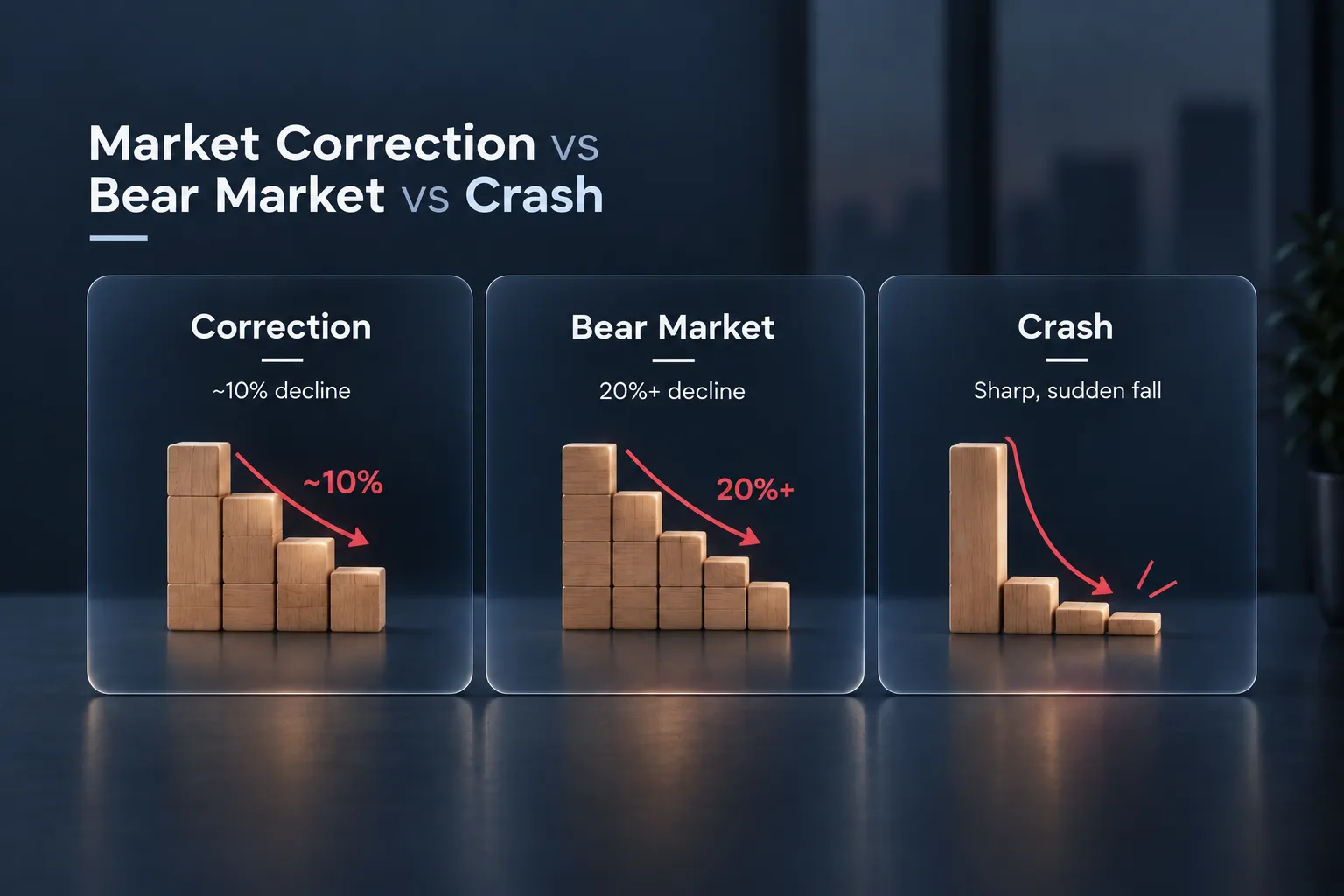
A market correction is generally used to describe a meaningful decline in market prices after a recent high.
In common market terminology, a decline of around 10% from a recent peak is often described as a correction, while a decline of 20% or more is commonly associated with a bear market. These are widely used conventions rather than fixed regulatory definitions.
But the percentage is only part of the story.
A market correction can be triggered by changing interest-rate expectations, economic concerns, geopolitical developments, corporate earnings, stretched valuations or simply a shift in investor sentiment.
What matters to an individual investor, however, is not just why the market is falling. It is whether the fall changes the reason they invested in the first place.
That distinction can change the way you respond to almost every market downturn.
A Market Correction Doesn't Change Your Goal Overnight
Think about why you invested.
Perhaps you're building a retirement corpus. Perhaps you're investing for your child's education.
Perhaps you're accumulating wealth for a future business, a home or financial independence.
The time horizon for those goals does not suddenly change because the market has had a difficult month.
Yet this is where investors can get caught in a difficult psychological loop. The market moves every day.
Your financial goals don't.
SEBI’s investor education resources advise investors to consider their goals, investment horizon, risk appetite, diversification and asset allocation while making investment decisions. They also emphasise matching investments with the investor’s time horizon and avoiding volatile or illiquid investments when the money may be required in the near future.
So before asking, “What is the market going to do next?”, ask something more relevant:
“Has anything changed about what I am investing for?”
If the answer is no, a correction may not require a dramatic change to your strategy.
Why Investors Often Make the Wrong Move during a market correction?
There is an uncomfortable truth about investing:
We don't experience volatility as numbers.
We experience it as emotion.
When markets are rising, risk feels manageable.
When markets fall, the same risk can suddenly feel unbearable.
A red portfolio can create an overwhelming need to do something, even when staying with a well-considered plan may be the more rational response.
That is why market corrections often bring out familiar behaviours:
Selling because the decline feels too uncomfortable
Stopping a SIP because investing during a downturn feels counterintuitive.
Chasing whatever asset or sector appears to be holding up.
Following predictions about when the market will bottom.
Trying to recover losses quickly.
The irony?
The desire to protect yourself from short-term volatility can sometimes lead to decisions that create greater long-term damage.
So, what should you actually do?
The 4 Questions to Ask Before You Make Any Move

Instead of reacting to the market first, start with yourself.
1. Has my financial goal changed?
If you're investing for a goal ten years away, ask whether that goal is still ten years away. If nothing has changed, a short-term market decline may not justify changing the entire strategy. But if you suddenly need the money sooner, that is different.
Your portfolio should evolve with your life, not with every market headline.
2. Has my ability or willingness to take risk changed?
A correction can reveal something your original risk assessment didn't: how you actually behave when markets fall.
You may have believed you were comfortable with equity volatility when markets were rising. Now you have a much more useful piece of information.
If a correction is causing you to lose sleep, repeatedly check your portfolio or consider abandoning your investments, your asset allocation may deserve a closer review.
Risk capacity reflects how much financial loss you can absorb, while risk tolerance reflects how much volatility you can realistically withstand without abandoning your plan.
3. Has something fundamentally changed in my investment?
This is one of the most important distinctions to make. A falling market price and a deteriorating investment are not automatically the same thing.
Ask: Are the fundamentals of the underlying investment or portfolio still sound?
Has the investment thesis changed?
Has the portfolio become excessively concentrated?
Has the investment moved significantly away from its intended role?
Has my original reason for owning it changed?
These are more useful questions than simply asking:
“How much has it fallen?”
SEBI’s investor education resources advise investors not to rely solely on past performance, but to consider the fundamentals and future potential of an investment. They also recommend reviewing and rebalancing a portfolio to keep it aligned with its intended objectives.
4. Is my portfolio still built for the journey ahead?
Corrections can be uncomfortable.
It can also be revealing. It can show you whether your portfolio is appropriately diversified, whether your asset allocation still makes sense and whether the amount of risk you're taking is appropriate for your time horizon.
Diversification cannot eliminate market-wide volatility. But it may reduce the impact of poor performance in any one investment or asset class.
That makes a correction a good time to review the portfolio, not abandon the plan.
Should You Continue Your SIP During a Market Correction?
This is probably one of the most searched questions investors ask during a market downturn. And the answer is more nuanced than a simple yes or no.
A Systematic Investment Plan, or SIP, is a method of investing a fixed amount in a mutual fund scheme at regular intervals.
AMFI notes that SIPs can encourage disciplined investing and help investors avoid trying to time the market. However, rupee-cost averaging neither assures a profit nor protects investors against losses in declining markets.
So, if your SIP is linked to a long-term goal, your financial circumstances remain stable, and the underlying investment continues to fit your risk profile and objectives, a correction by itself does not automatically mean the SIP should be stopped.
But continuing a SIP should still be periodically reviewed against your goals, financial circumstances, risk profile and the suitability of the underlying scheme.
Your financial goals can change.
Your income can change.
Your liquidity needs can change.
Your risk appetite can change.
The right approach is not “never stop investing.”
It is:
Don't change a long-term strategy merely because the market has changed for a short period.
Market Correction vs Market Crash: Don't Let the Label Derive Your Decision
Investors often use correction, crash, decline and bear market interchangeably.
They aren't exactly the same.
A correction generally refers to a moderate decline from a recent high.
A bear market is commonly associated with a decline of 20% or more.
A market crash typically refers to a much sharper and more sudden fall.
The terminology matters less than what it makes investors feel.
Because once the word crash enters the conversation, rational analysis can quickly be replaced by fear.
And fear has a habit of making every short-term decision feel urgent.
Your portfolio, however, should not be managed by headlines.
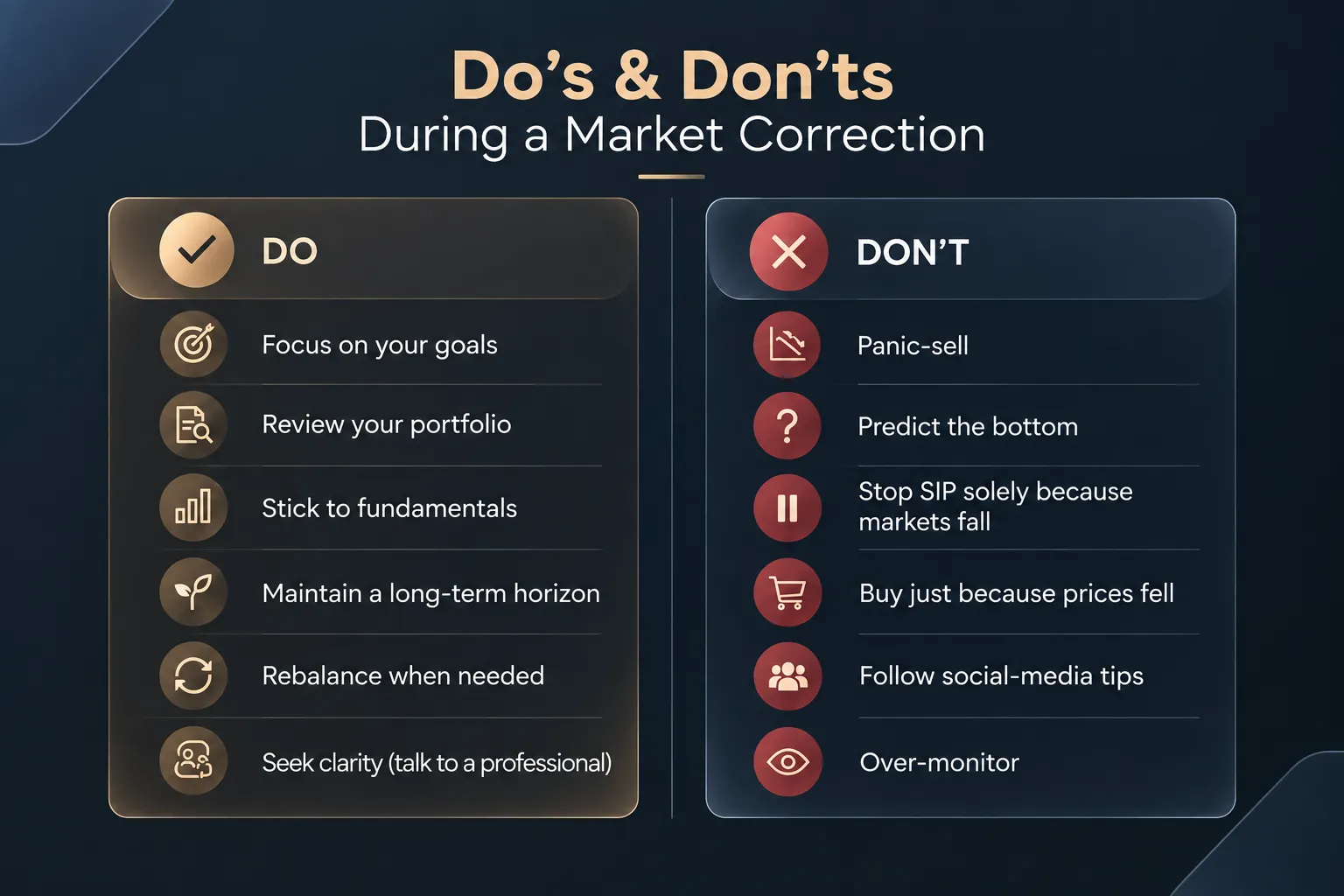
The Do's During a Market Correction
Do go back to your goals.
Ask what the money is for, when you'll need it and whether anything has materially changed.
Do review your portfolio.
Look at asset allocation, diversification, concentration and risk exposure.
Do focus on the investment, not just the price.
A lower price does not automatically mean a better investment.
Do keep your long-term horizon in perspective.
Short-term volatility can feel significant while still being relatively small compared with a multi-year investment horizon.
Do rebalance when necessary.
If market movements have materially changed your intended asset allocation, rebalancing may bring the portfolio back in line with the original strategy.
Do seek clarity before taking action.
If you aren't sure whether your portfolio still reflects your goals, seeking guidance from an appropriately qualified and regulated professional may be more useful than consuming another ten market predictions.
The Don'ts During a Market Correction
Don't panic-sell.
Don’t sell solely because a temporary decline feels uncomfortable. However, selling may be appropriate when the investment thesis has changed, the portfolio requires rebalancing or the investment no longer suits your goals and risk profile.
Don't try to predict the exact bottom.
There is no reliable way to know the precise day or level at which a market will turn.
Don't stop a SIP solely because markets are falling.
First ask whether your financial plan or the underlying investment has actually changed.
Don't invest simply because something has fallen.
A market decline can create opportunities, but a falling price alone isn't an investment thesis.
Don’t act on unverified social media tips.
Verify the source, credentials and regulatory status of anyone offering investment recommendations, and do not make investment decisions solely on the basis of social media posts or informal tips.
- Don't confuse activity with progress.
Checking your portfolio ten times a day doesn't make it ten times better managed. Perhaps the Most Important Investment Decision Is the One You Don't Make in a Hurry
During a market correction, everyone wants an answer.
Will it fall further?
When will it recover?
Should I buy the dip?
Should I exit?
But some of the most useful investment questions have nothing to do with predicting tomorrow.
They are questions about your own financial plan.
What am I investing for?
When will I need this money?
Am I taking the right amount of risk?
Is my portfolio still diversified?
Has anything fundamentally changed?
These questions bring the conversation back to where it belongs: your financial journey.
Where Guidance Can Make a Difference
Technology has made investing easier. You can track your portfolio in real time.
You can compare products. You can access market news within seconds. But accessibility doesn't always create clarity.
When markets become volatile, the challenge isn't necessarily finding more information. It is knowing which information deserves your attention.
That is where a Financial Product Distributor can play a meaningful role - not by predicting the next market move, but by helping investors understand product features, risks and suitability considerations in the context of their stated goals, risk profile and investment horizon. Where personalised investment advice is required, investors should consult a SEBI-registered Investment Adviser.
Sometimes, the most valuable conversation during a market downturn isn't:
“Where is the market going?”
It's:
“Are we still going where we planned to go?”
The Bottom Line: A Market Correction Tests Your Plan - It Doesn't Automatically Invalidate It.
No investor can eliminate market volatility. And no one can consistently predict every correction, recovery or market bottom.
What investors can control is how they respond.
A market downturn can tempt you to chase certainty.
A disciplined investment approach helps you stay focused on what actually matters.
Your goals.
Your time horizon.
Your risk appetite.
Your portfolio.
And your ability to stay invested through uncertainty. Because successful investing isn't about making the perfect decision every time the market moves.
It's about building a financial strategy that doesn't require you to make perfect prediction in the first place.
When the market gets noisy, clarity becomes an advantage. And sometimes, the smartest response to market correction isn't to react faster.
It's to think better.
If you’re a partner, looking to grow your business, click here - Invest with Expert Guidance. Grow with Confidence. | Centricity
If you’re an investor, starting your investment journey, click here- Invest Yourself | Centricity
Disclaimer: This article is for general educational purposes only and should not be construed as investment advice or a recommendation to buy, sell or hold any security or financial product. Investments in securities markets and mutual funds are subject to market risks. Investors should read all relevant scheme- and product-related documents carefully and evaluate their financial circumstances, goals, risk profile and investment horizon before investing. Where necessary, investors should consult a SEBI-registered Investment Adviser. Past performance does not guarantee future returns.